Vercel Data Breach 2026: How One AI Tool Put a Billion-Dollar Company at Risk

1. Introduction — A Shocking Wake-Up Call
Imagine waking up one morning to a notification saying your company's internal systems were just hacked — and the entry point was a small productivity app one of your employees installed.
That is exactly what happened to Vercel, the billion-dollar cloud hosting company trusted by millions of developers worldwide, in April 2026.
The Vercel data breach 2026 is not just another corporate hack story. It is a textbook example of a supply chain attack — where hackers don't break down your front door, they walk in through a window you didn't even know was open.
A single employee at Vercel installed a third-party tool called Context AI. That small action gave sophisticated hackers enough access to infiltrate Vercel's internal systems, steal customer credentials, and later try to sell the data for $2 million on a cybercriminal forum.
In this article, we break everything down — from what happened and how, to what you can do right now if you're a Vercel user. Even if you've never heard of Vercel before, by the end of this article you'll understand why this breach matters to every developer and business on the internet.
Let's start from the basics.
2. What Is Vercel? (Quick Background)
Before we dive into the breach, let's understand who Vercel is.
Vercel is a cloud platform that developers use to deploy and host web applications — especially those built with Next.js, a popular JavaScript framework. Think of it as a super-fast, developer-friendly service that takes your code and puts it on the internet in seconds.
Some quick facts about Vercel:
- Founded: 2015 (originally called ZEIT)
- CEO: Guillermo Rauch
- Valuation: Over $3.2 billion (as of 2023 funding round)
- Users: Millions of developers and thousands of companies worldwide
- Popular products: Next.js (open-source), Vercel platform, v0 (AI app builder) Vercel powers the websites and apps of many top companies. When something goes wrong at Vercel, it doesn't just affect Vercel — it can potentially affect hundreds of organizations that rely on its infrastructure.
3. What Happened? The Vercel Breach Explained Simply
Here's the short version:
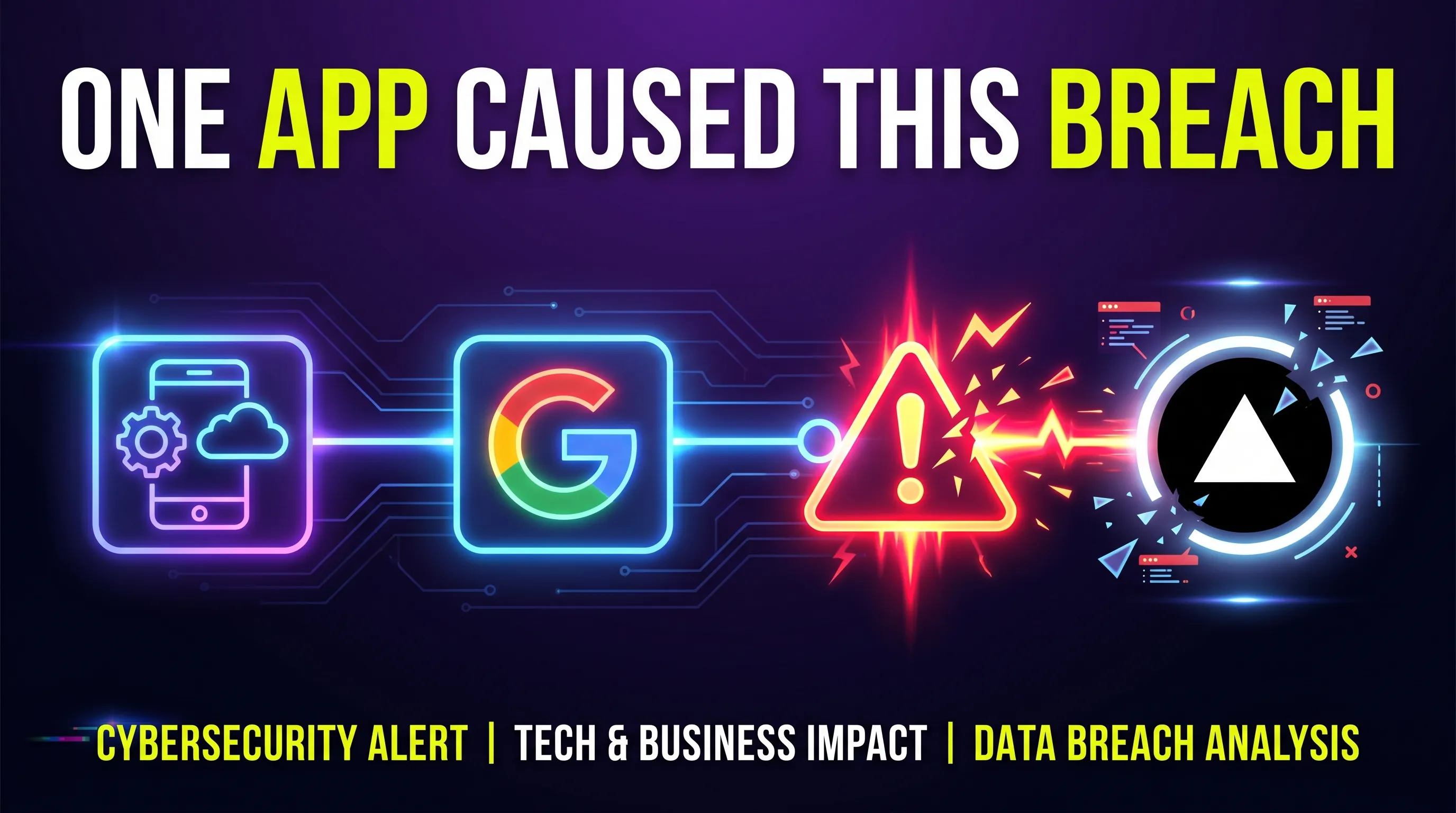
- A Vercel employee installed and connected a third-party tool called Context AI to their work Google account.
- Hackers had already compromised Context AI — specifically its Google Workspace OAuth connection.
- Through that connection, hackers took over the employee's Google Workspace account.
- Using that Google account, they gained access to some of Vercel's internal systems and environment variables.
- Customer credentials were stolen and exposed.
- A hacker using the ShinyHunters name later claimed to be selling the stolen data for $2 million. That's the whole story in six steps. Now let's understand each piece in detail.
4. What Is Context AI? The Third-Party Tool at the Center
Context AI is a startup that builds evaluation and analytics tools for AI models. In simpler words — it helps companies measure and understand how well their AI products are working.
Context AI also has a product called the Context AI Office Suite, a consumer-facing app that lets users automate tasks and workflows across multiple apps. Think of it like Zapier — it connects to your Google account, Slack, calendar, and so on, and automates things for you.
The problem? This app connects to your Google Workspace through a method called OAuth. And that OAuth connection became the hacker's entry point.
According to Context AI's own security update posted on their website:
- Their app was compromised in March 2026
- Hackers likely compromised OAuth tokens for some of their users
- They initially notified only one customer about the breach
- After hearing about the Vercel incident, Context AI now believes the scope was much broader than first thought Context AI did not respond to media requests for comment. It's also not clear why they didn't disclose the full extent of the breach earlier — which raises serious questions about their incident response practices.
5. How the Attack Actually Worked — Step by Step
Let's walk through the hack like a detective reconstructing a crime scene.
Step 1 — Context AI Gets Compromised
At some point in March 2026, hackers broke into Context AI's infrastructure. They specifically targeted the part of Context AI that handled OAuth connections — the tokens that allow Context AI to access users' Google accounts.
Step 2 — Employee Installs the App
A Vercel employee had installed the Context AI app and connected it to their Google Workspace account. This was probably for productivity reasons — there was nothing obviously suspicious about using such a tool.
Step 3 — Hackers Steal the OAuth Token
With control over Context AI's OAuth system, the hackers now had an active OAuth token that let them access the employee's Google Workspace account — just as if they were that employee.
Step 4 — Google Workspace Takeover
Using that token, attackers logged into the employee's Google account. They could now read emails, access Google Drive, and — most critically — use any other tool that was connected to that Google account.
Step 5 — Gaining Access to Vercel's Internal Systems
From the compromised Google account, the attackers were able to access certain internal Vercel systems and read environment variables that were not marked as "sensitive."
Environment variables are like secret keys that your app uses — things like API keys, database passwords, and access tokens.
Step 6 — Data Exfiltration
The hackers collected the exposed credentials and environment variable values. Vercel confirmed that "sensitive" environment variables (which are encrypted and unreadable even internally) were NOT accessed. But the non-sensitive ones were exposed.
6. What Is OAuth? Why It Matters in This Hack
OAuth (OAuth authorization) is a security standard that lets one app access your account on another app — without sharing your password.
You've probably used OAuth without knowing it. Ever seen a button that says "Sign in with Google" or "Connect with GitHub"? That's OAuth.
Here's a simple analogy: Imagine you're at a hotel. Instead of giving every service (the gym, the pool, the restaurant) a copy of your room key, the hotel gives you separate access cards for each. OAuth is like those access cards — each app gets its own "key" to access only what it needs.
The problem in this breach: When hackers compromised Context AI, they effectively stole those "access cards" (OAuth tokens). And one of those cards happened to give access to a Vercel employee's Google account — which then opened the door to Vercel's internal systems.
This is exactly why OAuth security and third-party app vetting are so critical for companies.
7. What Data Was Stolen?
Here's what we know based on Vercel's official bulletin and media reports:
| Data Type | Exposed? | Notes |
|---|---|---|
| Environment variables (non-sensitive) | Yes | Potentially included API keys, tokens, DB credentials |
| Environment variables (sensitive/encrypted) | No | Encrypted, no evidence of access |
| Customer credentials (limited subset) | Yes | Vercel contacted affected customers directly |
| Source code (Next.js, Turbopack) | No | Vercel confirmed open-source projects are safe |
| Full database | Unclear | ShinyHunters claims include "database data" — unverified |
| Customer API keys | Likely | Included in hacker's claimed data for sale |
The hackers claiming to sell the data said they had access to customer API keys, source code, and database data. However, Vercel has only confirmed a limited subset of customers were impacted and that sensitive environment variables were protected.
8. ShinyHunters: Who Are They?
ShinyHunters is one of the most notorious hacking groups in the cybersecurity world. They are known for:
- Breaching cloud-based and database-heavy companies
- Stealing and selling large amounts of user data
- High-profile previous attacks including AT&T, Ticketmaster, and other major companies In this breach, a threat actor claimed to be acting under the ShinyHunters name when listing the stolen Vercel data on a cybercriminal forum.
However — and this is important — ShinyHunters themselves told BleepingComputer that they are NOT involved in this incident. So either:
a) A copycat is using their name to add credibility to the sale, or
b) There's some internal disagreement or misattribution within the group
b) There's some internal disagreement or misattribution within the group
Either way, the data listing and the $2 million asking price are real — someone is trying to sell something, regardless of who they are.
9. The $2 Million Claim — What Are Hackers Selling?
According to reports from TechCrunch, India Today, and Bleeping Computer, a threat actor posted on a cybercriminal forum claiming to sell stolen Vercel data.
The listing claimed to include:
- Customer API keys
- Source code
- Database data
- Access credentials The asking price? $2 million.
This kind of data sale is extremely dangerous because:
- API keys can give direct access to cloud services, leading to massive bills or worse
- Database credentials could expose end-user data downstream
- Source code leaks can expose security vulnerabilities in customer apps Vercel has not confirmed the full extent of what was stolen, and the investigation is still ongoing as of April 20, 2026.
10. What Vercel Said Officially
Vercel published a security bulletin on April 19–20, 2026. Here are the key points from their official statement:
- They identified unauthorized access to certain internal Vercel systems
- The breach originated with a compromise of Context AI, a third-party tool used by a Vercel employee
- The attacker used Context AI's access to take over the employee's Google Workspace account
- Environment variables NOT marked as sensitive were potentially accessed
- Sensitive environment variables (stored encrypted) show no evidence of being accessed
- They consider the attacker "highly sophisticated" based on operational speed and deep knowledge of Vercel's systems
- They are working with Mandiant (Google's cybersecurity firm) and other security firms
- Law enforcement has been notified
- They engaged Context AI directly to understand the full scope
- They published an OAuth App Indicator of Compromise (IOC) to help other organizations check if they are affected The IOC published by Vercel:
110671459871-30f1spbu0hptbs60cb4vsmv79i7bbvqj.apps.googleusercontent.com
If you're a Google Workspace admin, check immediately for any usage of this OAuth application.
11. What Vercel CEO Guillermo Rauch Said
Vercel CEO Guillermo Rauch took to X (formerly Twitter) to address customers. He advised customers to:
- Rotate any API keys and credentials in their Vercel deployments that are not marked as "sensitive"
- Reassured the community that Next.js and Turbopack (open-source projects) remain safe
- Announced that Vercel has rolled out new dashboard capabilities including:
- An overview page for environment variables
- A better UI for sensitive environment variable creation and management He also confirmed that Vercel had analyzed its supply chain, ensuring their open-source projects remain secure for the community.
12. What Is a Supply Chain Attack? (And Why It's Getting Worse)
The Vercel breach is a perfect example of a supply chain attack. Let's understand what this means.
Think of it like this: You live in a very secure house with triple locks on the front door, cameras everywhere, and a guard dog. But your pizza delivery guy has a key to open your gate — and someone has stolen that key.
A supply chain attack works the same way. Instead of attacking a strong company directly, hackers target a smaller, less secure vendor or tool that the big company trusts and uses.
Why supply chain attacks are so dangerous:
- They are hard to detect — the attacker enters through a legitimate, trusted connection
- They can affect hundreds or thousands of companies through a single vendor breach
- They exploit the trust between companies and their software tools Recent high-profile supply chain attacks include the SolarWinds hack (2020), the 3CX hack (2023), and now this Context AI → Vercel chain (2026).
According to cybersecurity researchers, supply chain attacks increased by over 300% between 2020 and 2024, and the trend is continuing into 2026. Learn more about securing your software supply chain.
13. Sensitive vs Non-Sensitive Environment Variables — Know the Difference
One of the most important technical lessons from this breach is understanding Vercel's sensitive environment variables feature. This is crucial for every developer using Vercel. For broader context on secret management, see OWASP Secret Management Cheat Sheet.
What are Environment Variables?
Environment variables are configuration values your app needs to run — things like:
DATABASE_URL— your database connection stringAPI_SECRET_KEY— a private key to authenticate with an external serviceSTRIPE_SECRET_KEY— your payment gateway credentials These are stored in your deployment environment, not in your code (for security reasons).
Sensitive vs Non-Sensitive on Vercel
| Feature | Non-Sensitive | Sensitive |
|---|---|---|
| Readable in dashboard | Yes | No (write-only) |
| Readable via CLI | Yes | No |
| Can be read if account is compromised | Yes — EXPOSED | No — PROTECTED |
| Use case | Non-secret config values | API keys, passwords, tokens |
In the Vercel breach: Attackers accessed environment variables that were not marked as sensitive. Values marked as sensitive were stored in a way that even Vercel can't read them — and the attackers couldn't either.
💡Pro Tip: If your environment variable contains anything secret — API keys, database passwords, signing keys — always mark it as sensitive in Vercel. This one habit could be the difference between a breach and a near-miss.
14. What Should Vercel Users Do Right Now?
If you use Vercel for any project, here are immediate action steps recommended by Vercel:
Immediate Actions (Do These Today)
- Review your activity log — Go to vercel.com/activity-log and look for anything suspicious — logins, deployments, or API calls you don't recognize.
- Rotate ALL non-sensitive environment variable secrets — If you have API keys, database credentials, or any secrets that were NOT marked sensitive, treat them as compromised and regenerate them right now.
- Mark secrets as "Sensitive" — Going forward, use Vercel's sensitive environment variable feature for any value that is a secret.
- Check recent deployments — Go to your deployments page and look for any unexpected or suspicious-looking deployments. Delete any you can't explain.
- Rotate Deployment Protection tokens — If you use Deployment Protection, rotate those tokens immediately.
- Set Deployment Protection to Standard — Go to your team settings and ensure Deployment Protection is at least set to "Standard."
For Google Workspace Admins
- Search for the malicious OAuth app — Check your Google Workspace admin panel for any usage of this OAuth app ID:
If found, revoke access immediately and investigate which accounts it was connected to.110671459871-30f1spbu0hptbs60cb4vsmv79i7bbvqj.apps.googleusercontent.com - Audit all third-party OAuth connections — Review every app connected to your organization's Google Workspace accounts. Remove any you don't recognize or no longer need.
Long-Term Security Steps
- Implement a Third-Party App Policy — Require security review before any employee connects a third-party tool to company accounts.
- Use a password manager + rotate credentials regularly — Make credential rotation a scheduled habit, not a reactive measure.
- Enable multi-factor authentication (MFA) — Everywhere. No exceptions.
15. Could This Have Been Prevented?
This is the painful question every security team is asking after a breach. The honest answer: maybe.
Here's what could have helped:
| Prevention Measure | Would It Have Helped? |
|---|---|
| Strict third-party app approval policy | Likely yes — the Context AI app might not have been approved |
| All environment variables marked as sensitive | Yes — exposed data would have been encrypted |
| OAuth access token monitoring/alerts | Possibly — unusual OAuth activity might have been flagged earlier |
| Regular credential rotation | Partially — would limit damage window |
| Zero-trust network architecture | Likely yes — limits what a compromised account can access |
| Endpoint detection on employee devices | Partially — might not help with OAuth-based attacks |
The trickiest part? The attacker was "highly sophisticated" according to Vercel itself. They understood Vercel's systems deeply and moved quickly. Even well-prepared companies can fall victim to targeted, sophisticated attacks.
But the lesson is clear: the weakest link was a third-party tool's OAuth access, not Vercel's core infrastructure. That's the supply chain attack in action.
16. Broader Impact — Other Companies at Risk
This isn't just a Vercel problem. Vercel itself warned that the breach may affect "hundreds of users across many organizations" — not just Vercel.
Because Context AI's Office Suite was used by many different companies, any of those organizations could have had their Google Workspace accounts compromised through the same OAuth vulnerability.
This means companies that:
- Used the Context AI Office Suite at any point
- Connected it to their Google Workspace account
- Have Google accounts with access to internal systems ...should all be investigating immediately.
The downstream risk is significant. If hackers gained OAuth tokens for hundreds of organizations, they could have — or still may be — accessing systems beyond just Vercel.
Context AI has acknowledged the breach was "likely broader" than they first thought, which is a concerning admission.
17. Comparison Table — Vercel Breach vs Other Major Dev Breaches
| Breach | Year | Entry Point | Data Stolen | Impact Level | Attacker |
|---|---|---|---|---|---|
| Vercel / Context AI | 2026 | OAuth token via 3rd-party app | Customer credentials, env vars | High | Claimed ShinyHunters |
| SolarWinds | 2020 | Malicious software update | US govt systems, 18,000+ orgs | Critical | Nation-state (Russia) |
| Codecov | 2021 | CI/CD pipeline injection | Env variables, secrets | High | Unknown |
| 3CX | 2023 | Compromised 3rd-party library | Call data, credentials | High | North Korea-linked |
| Snowflake | 2024 | Stolen credentials + no MFA | Customer databases | Critical | UNC5537 group |
| Anodot | 2026 | Supply chain | Multiple companies affected | High | Unknown |
A clear pattern emerges: supply chain attacks through trusted tools are the dominant threat vector for developer-focused companies in 2026.
18. Pro Tips for Developers: Secure Your Deployment Environment
Whether you use Vercel or any other cloud hosting platform, these best practices will dramatically reduce your risk:
Pro Tip #1: Never store secrets in non-sensitive environment variables. Always mark API keys, database passwords, and tokens as "sensitive" or encrypted equivalents on your platform.
Pro Tip #2: Audit your OAuth connections quarterly. Review what apps have access to your Google, GitHub, or any corporate account every 3 months. Remove what you don't actively use.
Pro Tip #3: Set up alerts for new OAuth app connections. Most enterprise Google Workspace and Microsoft 365 accounts allow you to alert admins when a new app requests OAuth access. Enable this.
Pro Tip #4: Rotate credentials on a schedule. Don't wait for a breach. Rotate API keys and database passwords every 90 days as a default habit.
Pro Tip #5: Adopt a Zero Trust mindset. Treat every account, app, and user as potentially compromised. Require re-authentication for sensitive operations.
Pro Tip #6: Have an incident response plan. Know who to call, what to do, and how to communicate if your company's systems are breached. Don't figure it out during the crisis.
Pro Tip #7: Vet third-party tools before connecting them to company accounts. Especially tools that require access to Google Workspace, Slack, GitHub, or any internal system. Check their security track record and published policies.
19. Conclusion — The Lesson Every Developer Must Learn
The Vercel data breach of 2026 is a story that will be told in cybersecurity courses for years.
It wasn't a sophisticated zero-day exploit in Vercel's core infrastructure. It wasn't a state-sponsored nation-state attack on their servers. It was something far more common — and far more preventable — a trusted employee used a third-party tool, that tool was compromised, and the chain of trust collapsed.
This is the reality of modern cybersecurity: your security is only as strong as the weakest tool your team uses.
The key takeaways from this incident:
- Vet every third-party tool before connecting it to company accounts
- Mark all secrets as sensitive in your deployment environments
- Audit OAuth connections regularly and remove what you don't need
- Rotate credentials proactively, not just after a breach
- Supply chain attacks are the dominant threat in 2026 — prepare accordingly Whether you're a solo developer, a startup founder, or a security engineer at a large enterprise, the habits you build today will determine whether a breach like this becomes your company's story or just a news article you read.
🔔 Take Action Now
If you're a Vercel user: Go to vercel.com/activity-log and check for suspicious activity right now. Rotate any non-sensitive secrets today.
If you're a Google Workspace admin: Check for the malicious OAuth app ID published by Vercel and audit all third-party app connections in your organization.
If you're a developer: Bookmark this article, share it with your team, and implement the 7 Pro Tips listed above.
Liked this article? Share it with someone who uses Vercel or runs a tech startup. This information could save them from a very bad day.